
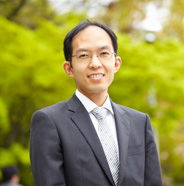
Hirokata Fukushima
Professor
Faculty of Sociology, Kansai University
Tel: +81-6-6368-0732
Email: fukush<<at>>kansai-u.ac.jp
Biography
Academic positions
- 2019–present: Professor, Kansai University
- 2016: Visiting Researcher, Institute of Psychology and Education, Ulm University, Germany
- 2012: Associate Professor, Kansai University
- 2011: Assistant Professor, Kansai University
- 2010: Visiting Researcher, Center for Mind and Brain, University of California, Davis, USA
- 2008: Postdoctoral Fellow, Keio University, Japan Society for the Promotion of Science(JSPS)
- 2005: Research Associate, The University of Tokyo, JSPS
Education
- 2006: Ph.D., The University of Tokyo
- 2003: M.A., The University of Tokyo
- 2001: B.A., The University of Tokyo
Research Area
Social, cognitive, and affective psychophysiology and neuroscience.
One of my research goals is to understand the functional structure underlying the sense of self. In line with current trends in cognitive neuroscience, I consider the body, and mind-body interactions more broadly, to play an essential role in the sense of self. I therefore investigate how the body shapes emotion and the feeling of self.
Currently, I examine various aspects of interoception, that is, the processing of physiological(visceral)information in the brain and mind. I investigate how interoception relates to cognitive and affective behavior and personality.
My research includes
- Methods for assessing interoception, interoceptive awareness, and emotional awareness.
- Relationships among multiple levels of self-monitoring: physiological monitoring (interoception), behavioral monitoring(error detection), and psychological monitoring (self-reflection and mentalizing).
- Relationships between self-recognition and the recognition of others, including affective and cognitive empathy.
- Disruptions of mind-body interaction(e.g., alexithymia), affective and social development, and neurodevelopmental conditions(e.g., autism).
Physiological measurements
EEG/ERP, ECG(including HRV), respiration, and fMRI.
Publications in English
- Tanaka, Y., Araki, T., & Fukushima, H.(2026). Somatic sensations throughout the pregnancy: Their time course along with gestational weeks and relation to maternal-fetal attachment. BMC Pregnancy and Childbirth, 26, 241. [journal page]
- Liu, J., & Fukushima, H.(2025). Beyond emotional distress: Exploring the positive link between highly sensitive person trait and aesthetic sensitivity. Personality and Individual Differences, 245, 113285. [journal page]
- Liu, J., Diessner, R., & Fukushima, H.(2024). Development of the Engagement with Beauty Scale-Revised, Japanese Version(EBS-R-J), and confirmation of its validity and reliability. Japanese Psychological Research. Advance online publication. [journal page]
- Liu, J.*, & Fukushima, H.*(2023). Effects of alexithymia and its sub-factors on emotional response to music. Psychology of Music, 51(2), 412–428. [journal page]
- Imafuku, M.*, Fukushima, H.*, Nakamura, Y., Myowa, M., & Koike, S.(2020). Interoception is associated with the impact of eye contact on spontaneous facial mimicry. Scientific Reports, 10, 19866. [journal page]
- Fukushima, H., Tanaka, Y., & Myowa, M.(2019). Temporal matching between interoception and exteroception: Electrophysiological responses in a heartbeat discrimination task. Journal of Psychophysiology, 33(4), 219–231. [journal page] [accepted manuscript]
- Koreki, A., Maeda, T., Fukushima, H., Umeda, S., Takahata, K., Okimura, T., Funayama, M., Iwashita, S., Mimura, M., & Kato, M.(2015). Behavioral evidence of delayed prediction signals during agency attribution in patients with schizophrenia. Psychiatry Research, 230(1), 78–83. [journal page]
- Sueyoshi, T., Sugimoto, F., Katayama, J., & Fukushima, H.*(2014). Neural correlates of error processing reflect individual differences in interoceptive sensitivity. International Journal of Psychophysiology, 94(3), 278–286. [journal page] [PDF]
- Tanaka, Y., Fukushima, H., Okanoya, K., & Myowa-Yamakoshi, M.(2014). Mothers' multimodal information processing is modulated by multimodal interactions with their infants. Scientific Reports, 4, 6623. [journal page]
- Fukushima, H., Hirata, S., Matsuda, G., Ueno, A., Fuwa, K., Sugama, K., Kusunoki, K., Hiraki, K., Tomonaga, M., & Hasegawa, T.(2013). Neural representation of face familiarity in an awake chimpanzee. PeerJ, 1, e223. [journal page]
- Fukushima, H., Goto, Y., Maeda, T., Kato, M., & Umeda, S.(2013). Neural substrates for judgment of self-agency in ambiguous situations. PLoS ONE, 8(8), e72267. [journal page]
- Hirata, S., Matsuda, G., Ueno, A., Fukushima, H., Fuwa, K., Sugama, K., Kusunoki, K., Tomonaga, M., Hiraki, K., & Hasegawa, T.(2013). Brain response to affective pictures in the chimpanzee. Scientific Reports, 3, 1342. [journal page]
- Terasawa, Y., Fukushima, H., & Umeda, S.(2013). How does interoceptive awareness interact with the subjective experience of emotion? An fMRI study. Human Brain Mapping, 34(3), 598–612. [journal page]
- Fukushima, H., Terasawa, Y., & Umeda, S.(2011). Association between interoception and empathy: Evidence from heartbeat-evoked brain potential. International Journal of Psychophysiology, 79(2), 259–265. [journal page] [PDF]
- Hirata, S., Matsuda, G., Ueno, A., Fuwa, K., Sugama, K., Kusunoki, K., Fukushima, H., Hiraki, K., Tomonaga, M., & Hasegawa, T.(2011). Event-related potentials in response to subjects' own names: A comparison between humans and a chimpanzee. Communicative & Integrative Biology, 4(3), 321–323. [journal page]
- Fukushima, H., Hirata, S., Ueno, A., Matsuda, G., Fuwa, K., Sugama, K., Kusunoki, K., Hirai, M., Hiraki, K., Tomonaga, M., & Hasegawa, T.(2010). Neural correlates of face and object perception in an awake chimpanzee(Pan troglodytes)examined by scalp-surface event-related potentials. PLoS ONE, 5(10), e13366. [journal page]
- Ueno, A., Hirata, S., Fuwa, K., Sugama, K., Kusunoki, K., Matsuda, G., Fukushima, H., Hiraki, K., Tomonaga, M., & Hasegawa, T.(2010). Brain activity in an awake chimpanzee in response to the sound of her own name. Biology Letters, 6(3), 311–313. [journal page]
- Fukushima, H., & Hiraki, K.(2009). Whose loss is it? Human electrophysiological correlates of non-self reward processing. Social Neuroscience, 4(3), 261–275. [journal page] [PDF]
- Ueno, A., Hirata, S., Fuwa, K., Sugama, K., Kusunoki, K., Matsuda, G., Fukushima, H., Hiraki, K., Tomonaga, M., & Hasegawa, T.(2008). Auditory ERPs to stimulus deviance in an awake chimpanzee(Pan troglodytes): Towards hominid cognitive neurosciences. PLoS ONE, 3(1), e1442. [journal page]
- Takahashi, T., Ikeda, K., Fukushima, H., & Hasegawa, T.(2007). Salivary alpha-amylase levels and hyperbolic discounting in male humans. Neuroendocrinology Letters, 28(1), 17–20. [PubMed]
- Fukushima, H., & Hiraki, K.(2006). Perceiving an opponent's loss: Gender-related differences in the medial-frontal negativity. Social Cognitive and Affective Neuroscience, 1(2), 149–157. [journal page] [PDF]
- Hirai, M., Senju, A., Fukushima, H., & Hiraki, K.(2005). Active processing of biological motion perception: An ERP study. Cognitive Brain Research, 23(2–3), 387–396. [journal page]
- Fukushima, H., Hirai, M., Arita, A., Kamewari, K., & Hiraki, K.(2004). Neural dynamics in human imitation revealed by ERP surface topography. NeuroReport, 15(13), 2129–2132. [journal page] [PDF]
- Hirai, M., Fukushima, H., & Hiraki, K.(2003). An event-related potentials study of biological motion perception in humans. Neuroscience Letters, 344(1), 41–44. [journal page]
Presentations in English
- Fukushima, H., Sueyoshi, T., Sugimoto, F., & Katayama, J.(2016). Association between error processing and heartbeat perception depends on emotional context. 10th FENS Forum of Neuroscience, Copenhagen, Denmark, July 6.
- Koreki, A., Maeda, T., Fukushima, H., Okimura, T., Takahata, K., Umeda, S., Iwashita, S., Kato, M., & Mimura, M.(2013). The "exaggerated self" in schizophrenia evaluated by the sense of agency task. 17th Annual Meeting of the Association for the Scientific Study of Consciousness, San Diego, USA, July.
- Fukushima, H., Maeda, T., Sawa, A., Goto, Y., Kato, M., & Umeda, S.(2013). Neural substrates for judgment of self-agency: An fMRI study. 11th World Congress of Biological Psychiatry, Kyoto, Japan, June 25.
- Kurita, S., Fukushima, H., Murohashi, H., Potter, R. F., & Lang, A.(2013). Event-related brain potentials during emotional pictures as a function of violent game exposure and motivational activation. Annual Meeting of the International Communication Association, London, UK, June 21.
- Fukushima, H., Terasawa, Y., & Umeda, S.(2009). Implicit association between interoception and empathy is suggested by heartbeat-evoked brain potential. New Frontiers in Social Cognitive Neuroscience, Sendai, Japan, November 27.
- Fukushima, H.(2009). Electrophysiological correlates of non-self reward processing reflect empathetic states and traits of individuals. 40th Annual Meeting of the Society for Neuroscience, Chicago, USA, October 19.
- Fukushima, H., & Umeda, S.(2009). Interoception for mentalizing: Heartbeat-evoked brain potential shows amplitude modulation in an "eyes task." 16th Annual Meeting of the Cognitive Neuroscience Society, San Francisco, USA, March.
- Terasawa, Y., Fukushima, H., & Umeda, S.(2009). The common and specific neural bases for emotional and bodily awareness. 49th Annual Meeting of the Society for Psychophysiological Research, Berlin, Germany, October. Psychophysiology, 46, S150.
- Ikeda, K., Takahashi, T., Fukushima, H., & Hasegawa, T.(2007). The effect of motivation and stress on the ERN and the P3. Annual Meeting of the Cognitive Neuroscience Society, New York, USA, May. Journal of Cognitive Neuroscience, Supplement, 200.
- Fukushima, H., & Hiraki, K.(2006). Perceiving outcomes of another's performance: Individual differences in the "social brain." 3rd International Workshop on Evolutionary Cognitive Sciences: Social Cognition, The University of Tokyo, Japan, June.
- Fukushima, H., & Hiraki, K.(2005). An ERP study of human self-monitoring and social awareness. 2nd International Workshop for Young Psychologists on Evolution and Development of Cognition, Kyoto, Japan, October.
- Fukushima, H., & Hiraki, K.(2005). An electrophysiological study of human self-monitoring and social awareness. Annual Meeting of the Cognitive Neuroscience Society, New York, USA, April. Journal of Cognitive Neuroscience, Supplement, 205.
- Fukushima, H., Hirai, M., Arita, A., Kamewari, K., & Hiraki, K.(2004). Brain activity in an imitative reaction-time task: An ERP study. 11th Annual Meeting of the Cognitive Neuroscience Society, San Francisco, USA, April. Program, p. 81.
- Fukushima, H., & Hiraki, K.(2004). An electrophysiological study of human self-monitoring and social awareness. 2nd International Workshop for Young Psychologists on Evolution and Development of Cognition, Kyoto University, Japan.
- Fukushima, H., & Hiraki, K.(2004). Imitation-related visuomotor integration: ERP and behavioral studies. 21st Century COE Program International Workshop: Exploring the Social Brain, The University of Tokyo, Japan, March.
- Fukushima, H., Hirai, M., & Hiraki, K.(2003). Slow cortical potentials elicited by visual motion processing. Annual Meeting of the Cognitive Neuroscience Society, San Francisco, USA, April.
- Fukushima, H., Hirai, M., & Hiraki, K.(2003). Two kinds of predictive time processing: Interval timing and continuous timing reflected by slow cortical potentials. ICCS/ASCS-2003 International Conference of Cognitive Science, Sydney, Australia, July. Proceedings, pp. 123–128.
- Shimada, S., Hiraki, K., Fukushima, H., Matsuda, G., & Oda, I.(2002). Correlation between prefrontal hemoglobin oxygenation and reaching-task performance: A near-infrared spectroscopy study. Annual Meeting of the Cognitive Neuroscience Society, San Francisco, USA, April. NeuroImage, 16(2), S39.