Dexterous Motion Generated by Mechanisms in Humans and Robots
Shouhei Shirafuji
Department of Mechanical Engineering
Faculty of Engineering Science
Kansai University
3-3-35 Yamate-cho, Suita, Osaka, Japan
srfj[at]kansai-u.ac.jp
Introduction
My laboratory is part of the Mechanics and Control Engineering Laboratory, which is jointly operated by four faculty members.
We welcome applications from international students who are interested in joining our laboratory for graduate study. Prospective international students are encouraged to refer to the Kansai University website for international admissions for information on application procedures and requirements.
Research
Analysis of muscloskeletal system and Its Application
The structures of the human body, including the musculoskeletal system acquired through evolution, are expected to be well adapted to motions closely related to daily life, such as walking and grasping. We analyze these structures to clarify their mechanical functions and investigate how those functions can be incorporated into robotic mechanisms.
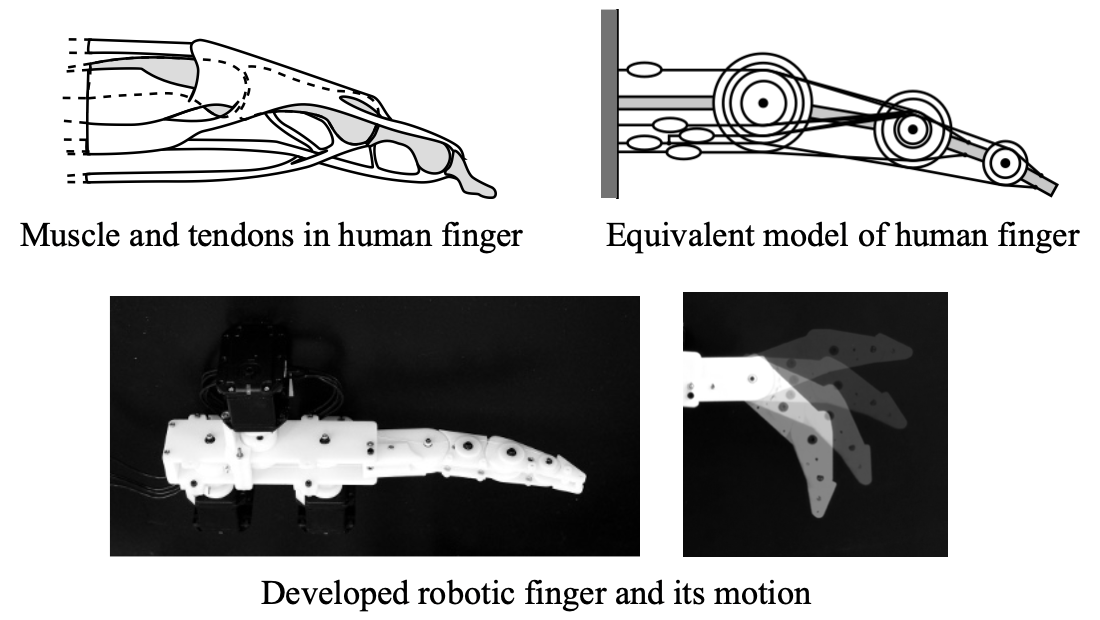
One outcome of this work is an anthropomorphic robotic finger that reproduces features of the human muscle–tendon system. Human fingers are driven by muscular forces transmitted through tendons, while many robotic hands likewise use tendon-driven mechanisms to coordinate multiple joints. Focusing on this similarity, we analyzed the human structure from kinematic and mechanism-theoretic viewpoints and developed the robotic finger shown in Fig. 1. The study revealed, for example, that branching tendons can effectively switch the mechanical behavior between the reaching phase before grasping and the manipulation phase after contact.
We also investigate other bio-inspired mechanisms and sensing systems, including tactile sensors for robotic hands that mimic structural features of human tactile receptors.
Fig. 1. Development of the anthropomorphic robotic finger.
Mechanism Design Using Wires and Tendons
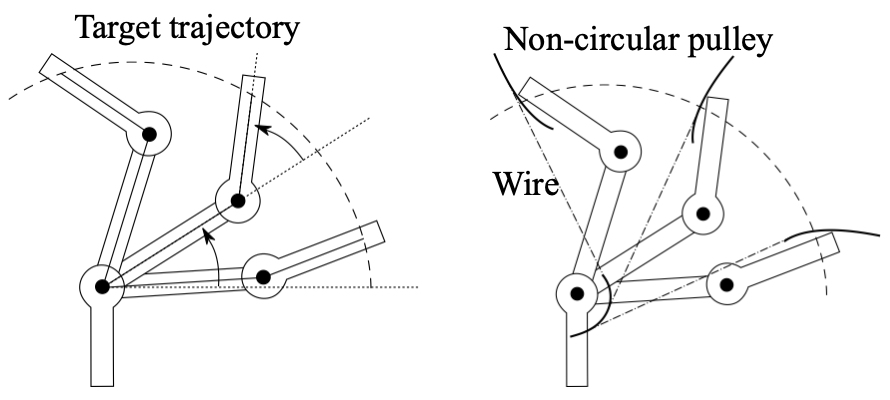
Most robots generate motion by controlling several independently actuated revolute joints. More complex coordination, however, can also be generated mechanically by constraining the relative motion of joint pairs. In our work, wires and their routing paths are used to impose such constraints (Fig. 2). In particular, we proposed a computational method for designing non-circular pulley profiles attached to the joints so that the wire realizes a prescribed nonlinear relationship between joint angles. Combining these constrained pairs makes it possible to coordinate multiple joints from a single input.
An application is the robotic leg mechanism shown in Fig. 3. By combining joint pairs constrained by non-circular pulleys and a wire, the mechanism can support a force applied to the upper body while progressing forward without active coordination of all joints. This illustrates how behavior normally achieved by control can instead be embedded in the mechanical structure. Because wires are lightweight and easily routed, this principle is applicable to a broad range of machines.
Fig. 2. Constraint of joints by a wire and a non-circular pulleyFig. 3. Development of the robotic leg with wire constraint
Automated Design of Robotic Mechanisms
Industrial manipulators are commonly designed with six or seven joints to maintain general-purpose dexterity. In many practical installations, however, the robot repeatedly follows a comparatively simple prescribed trajectory. Such a task may require fewer than six joints, but determining the appropriate number, type, and placement of joints for the specified motion is a nontrivial synthesis problem.
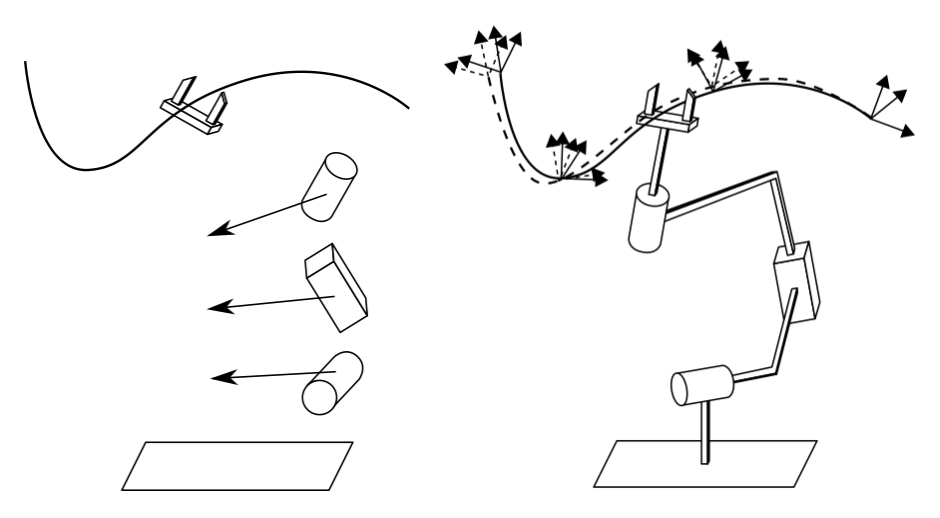
We proposed optimization-based methods for determining joint arrangements that realize a specified end-effector trajectory (Fig. 4). By exploiting an appropriate mathematical representation and derivatives, the computational cost of the repeated optimization can be reduced. Fig. 5 shows an example in which a three-joint manipulator follows a writing trajectory on a curved, egg-shaped surface while maintaining the tool orientation approximately normal to the surface. As rapid fabrication of customized mechanisms becomes increasingly practical, task-specific manipulator synthesis is expected to become more important.
Whereas kinematic analysis determines the motion produced by a given linkage, the inverse problem of determining a linkage or joint arrangement for a desired motion is known as kinematic synthesis. Our group studies this problem under a variety of task and design constraints.
Fig. 4. Design of joint displacements to follow a trajectoryFig. 5. Optimization of joint displacements
Cooperative Tasks by Simple Robots
Mobile manipulation in warehouses and other large workspaces introduces a risk that unexpected forces during manipulation will destabilize or overturn the robot. As the number of active degrees of freedom increases, control becomes more complicated and can become more sensitive to modeling errors and unmodeled external forces.
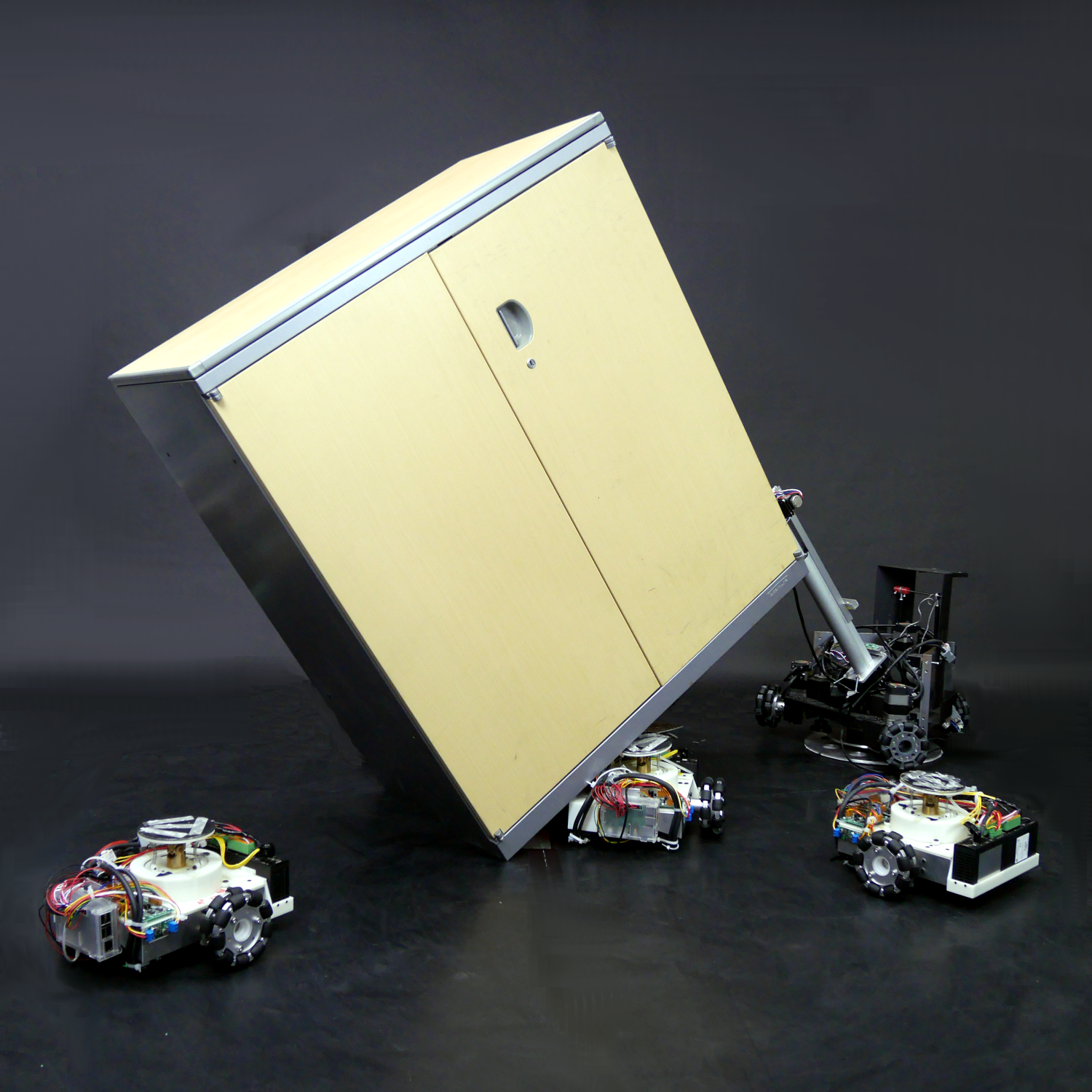
We therefore investigate cooperative manipulation by multiple robots whose individual functions are deliberately simplified. The robot in Fig. 7, for example, is specialized for applying a pushing force to an object; passive joints mechanically reject off-axis loads. This allows exploratory manipulation such as tilting a heavy object (Fig. 6). Combining such robots with others specialized for supporting or transporting objects enables cooperative manipulation adapted to the situation (Fig. 7).
Fig. 6. Demonstration that an ARODA inclined a heavy objectFig. 7. Cooperative manipulation by simple robots
Non-invasive Measurement of Human Motion and Muscle Activity
Understanding the human musculoskeletal system requires accurate measurement of motion and internal physiological phenomena. For measurements across many participants, these quantities must be acquired without damaging or invasively instrumenting the body. We therefore also develop non-invasive measurement methods.
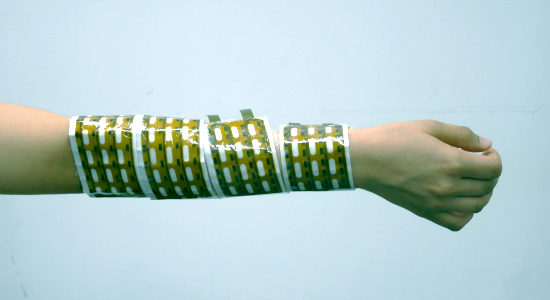
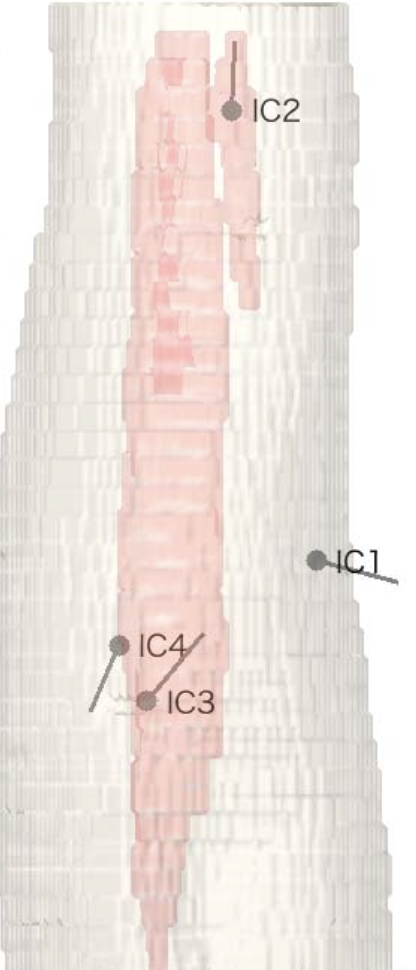
One example is the estimation of forearm muscle activity and its source locations using high-density surface electromyography (Fig. 8). Conventional surface EMG estimates muscle activity from potentials measured on the skin, but accurate separation is difficult in regions such as the forearm where many muscles are densely packed. Dense electrode arrays exploit small spatial differences in the measured potentials, enabling both source separation and spatial estimation (Fig. 9).
Related work includes techniques for accurately measuring joint motion and other methods supporting quantitative measurement and modeling of the human musculoskeletal system.
Fig. 8. High density electromyographyFig. 9. Estimated sources of muscle activity
Publications
Journal Articles (First/Corresponding Author)
Shouhei Shirafuji and Keiichiro Shimamura: "Kinematic Synthesis of a Serial Manipulator Using Gradient-Based Optimization on Lie Groups," IEEE Robotics and Automation Letters, IEEE, vol.10, no.3, pp.2550-2557, 2025.
Shouhei Shirafuji, Hiroki Goto, Xiaotian Zhang, Keiji Okuhara, Noritaka Takamura, Naoya Kagawa, Hiroyasu Baba, and Jun Ota: "Visual-Biased Observability Index for Camera-Based Robot Calibration," Journal of Mechanisms and Robotics, American Society of Mechanical Engineers, vol.16, no.5, 051010, 2024.
Shouhei Shirafuji, Masafumi Kobayashi, and Jun Ota: "Estimating Finger Joint Motions Based on the Relative Sliding of Layered Belts," IEEE Sensors Journal, IEEE, vol.22, issue 19, pp.18366-18375, 2022.
Shouhei Shirafuji and Jun Ota: "Development of a Robotic Finger with a Branching Tendon Mechanism and Sensing Based on the Moment-Equivalent Point," Robotics and Autonomous Systems, Elsevier Science B.V., vol.129, pp.103538, 2020.
Shouhei Shirafuji and Jun Ota: "Kinematic Synthesis of a Serial Robotic Manipulator by Using Generalized Differential Inverse Kinematics," IEEE Transactions on Robotics, IEEE, vol.35, issue 4, pp.1047-1054, 2019.
Shouhei Shirafuji, Yuri Terada, Tatsuma Ito, and Jun Ota: "Mechanism Allowing Large-Force Application by a Mobile Robot, and Development of ARODA," Robotics and Autonomous Systems, Elsevier Science B.V., vol.110, pp.92-101, 2018.
Shouhei Shirafuji, Taiki Ogata, Zhifeng Huang, Naotaka Matsui, Takeji Ueda, Jukai Maeda, Yasuko Kitajima, Masako Kanai-Pak, Yasushi Umeda, Hideyoshi Yanagisawa, and Jun Ota: "Study of Design Factors for Transfer-Aid Equipment Based on Caregivers' Feelings," Journal of Advanced Mechanical Design, Systems, and Manufacturing, The Japan Society of Mechanical Engineers, vol.12, no.1, pp.1-13, 2018.
Shouhei Shirafuji, Naotaka Matsui, and Jun Ota: “Novel Frictional-Locking-Mechanism for a Flat Belt: Theory, mechanism, and validation,” Mechanism and Machine Theory, Elsevier Science B.V., vol.116, pp.371-382, 2017.
Shouhei Shirafuji, Shuhei Ikemoto, and Koh Hosoda: “Designing Non-circular Pulleys to Realize Target Motion between Two Joints,” IEEE/ASME Transactions on Mechatronics, vol.22 no.1, pp.487-497, 2016.
Shouhei Shirafuji, Shuhei Ikemoto, and Koh Hosoda: “Development of a Tendon-Driven Robotic Finger for an Anthropomorphic Robotic Hand,” The International Journal of Robotics Research, SAGE Publications Ltd., vol.33, no.5, pp.677-693, 2014.
Shouhei Shirafuji and Koh Hosoda: “Detection and Prevention of Slip Using Sensors with Different Properties Embedded in Elastic Artificial Skin on the Basis of Previous Experience,” Robotics and Autonomous Systems, Elsevier Science B.V., vol.62, no.1, pp.46-52, 2014.
Journal Articles (Co-authored)
Fan Zeng, Changxiang Fan, Shouhei Shirafuji, Yusheng Wang, Masahiro Nishio, and Jun Ota: "Task Allocation and Scheduling to Enhance Human–Robot Collaboration in Production Line by Synergizing Efficiency and Fatigue," Journal of Manufacturing Systems, Elsevier Science B.V., vol.80, pp.309-323, 2025.
Xiaotian Zhang, Yusheng Wang, Shouhei Shirafuji, Naoya Kagawa, Noritaka Takamura, Keiji Okuhara, Hiroyasu Baba, and Jun Ota: "Visual-Based Joint Compliance Calibration Using Measurement Pose Optimization," International Journal of Automation Technology, Fuji Technology Press, vol.19, no.3, pp.204-215, 2025.
Changxiang Fan, Dongde Guan, Sai Xu, Guangjun Qiu, Shouhei Shirafuji, Jun Ota, and Jing Guo: "The Indication Reading Recognition Method of Pointer-Type Pressure Gauge Based on Image Processing," Measurement Science and Technology, IOP Publishing, vol.36, no.4, 045404, 2025.
Fan Zeng, Shouhei Shirafuji, Changxiang Fan, Masahiro Nishio, and Jun Ota: "Stepwise Large-Scale Multi-Agent Task Planning Using Neighborhood Search," IEEE Robotics and Automation Letters, IEEE, vol.9, issue 1, pp.111-118, 2024.
Changxiang Fan, Fan Zeng, Shouhei Shirafuji, and Jun Ota: "Development of a Three-Mobile-Robot System for Cooperative Transportation," Journal of Mechanisms and Robotics, American Society of Mechanical Engineers, vol.16, issue 4, JMR-22-1450, 2023.
Tetsuro Funato, Noriaki Hattori, Arito Yozu, Qi An, Tomomichi Oya, Shouhei Shirafuji, Akihiro Jino, Kyoichi Miura, Giovanni Martino, Denise Berger, Ichiro Miyai, Jun Ota, Yury Ivanenko, Andrea d'Avella, and Kazuhiko Seki: "Muscle synergy analysis yields an efficient and physiologically relevant way of assessing stroke," Brain Communications, Oxford University Press, vol.4, issue 4, fcac200, 2022.
Hamdi Sahloul, Shouhei Shirafuji, and Jun Ota: "An Accurate and Efficient Voting Scheme for a Maximally All-Inlier 3D Correspondence Set," IEEE Transactions on Pattern Analysis and Machine Intelligence, IEEE, vol.43, issue 7, pp.2287-2298, 2021.
Veerachart Srisamosorn, Noriaki Kuwahara, Atsushi Yamashita, Taiki Ogata, Shouhei Shirafuji, and Jun Ota: "Indoor human face following with environmental fisheye cameras and blimp," Advanced Robotics, Taylor & Francis, vol.34, issue 9, pp.621-636, 2020.
Enrico Piovanelli, Davide Piovesan, Shouhei Shirafuji, Becky Su, Natsue Yoshimura, Yousuke Ogata, and Jun Ota: "Towards a Simplified Estimation of Muscle Activation Pattern from MRI and EMG Using Electrical Network and Graph Theory," Sensors, MDPI, vol.30, no.3, 724, 2020.
Veerachart Srisamosorn, Noriaki Kuwahara, Atsushi Yamashita, Taiki Ogata, Shouhei Shirafuji, and Jun Ota: "Human position and head direction tracking in fisheye camera using randomized ferns and fisheye histograms of oriented gradients," The Visual Computer, Springer Science+Business Media, vol.36, pp.1443–1456, 2020.
Changxiang Fan, Shouhei Shirafuji, and Jun Ota: "Modal Planning for Cooperative Non-Prehensile Manipulation by Mobile Robots," Applied Sciences, MDPI, vol.9, no.3, 462, 2019.
Hamdi Sahloul, Shouhei Shirafuji, and Jun Ota: "3D Affine: An Embedding of Local Image Features for Viewpoint Invariance Using RGB-D Sensor Data," Sensors, MDPI, vol.19, no.2, 291, 2019.
Jorge David Figueroa Heredia, Shouhei Shirafuji, Hamdi Sahloul, Jose Rubrico, Taiki Ogata, Tatsunori Hara, and Jun Ota: “Refining Two Robots Task Execution through Tuning Behavior Trajectory and Balancing the Communication,” Journal of Robotics and Mechatronics, Fuji Technology Press Ltd., vol.30, no.4, pp.613-623, 2018.
Jorge David Figueroa Heredia, Jose Rubrico, Shouhei Shirafuji, and Jun Ota: “Teaching Tasks to Multiple Small Robots by Classifying and Splitting a Human Example,” Journal of Robotics and Mechatronics, Fuji Technology Press Ltd., vol.29, no.2, pp.419-433, 2017.
International Conferences
Yuta Totoki, Tetsuya Hasegawa, Shouhei Shirafuji, Jun Ota, and Arito Yozu: “Long short-term memory-based Gait Phase Prediction Using Heel Acceleration in People with Gait Disorders," 46th Annual International Conference of the IEEE Engineering in Medicine and Biology Society (EMBC), Orlando, FL, USA, July, 2024.
Ritsuki Nishizawa, Tetsuya Hasegawa, Shouhei Shirafuji, Jun Ota, and Arito Yozu: “Development of a Soft-Type Glove Capable of Customizing Finger Rehabilitation Exercises Considering Differences in Physique," 46th Annual International Conference of the IEEE Engineering in Medicine and Biology Society (EMBC), Orlando, FL, USA, July, 2024.
Tomu Makino, Tetsuya Hasegawa, Shouhei Shirafuji, Jun Ota, and Arito Yozu: “Evaluation of the Giving-Way-Prevention Function of a Soft Exosuit Incorporating the Multi-articular Muscle Mechanism," International Symposium on Micro-NanoMehatronics and Human Science, Nagoya, Japan, May, 2023.
Sho Okazaki, Shouhei Shirafuji, Toshinori Yasui, and Jun Ota: “A Framework to Support Failure Cause Identification in Manufacturing Systems through Generalization of Past FMEAs," IEEE/ASME International Conference on Advanced Intelligent Mechatronics, Seattle, WA, USA, June, 2023.
Kenta Hayakawa, Yusuke Kishita, Shinsuke Kondoh, Masahiro Nishio, Shouhei Shirafuji, and Yasushi Umeda: “Characteristic Analysis of Elderly Workers for Human-Centric Production Systems," CARE Innovation, 2023, Vienna, Austria, May, 2023.
Xiaotian Zhang, Hiroki Goto, Shouhei Shirafuji, Keiji Okuhara, Noritaka Takamura, Naoya Kagawa, Hiroyasu Baba, and Jun Ota: "Measurement Pose Optimization of Joint Offset Calibration Using a Hand-Eye Camera," 9th International Conference on Automation, Robotics and Applications, 2023, Abu Dhabi, United Arab Emirates, February, 2023.
Yasushi Umeda, Junpei Goto, Yuki Hongo, Shouhei Shirafuji, Hiroshi Yamakawa, Dongsik Kim, Jun Ota, Hiroki Matsuzawa, Takuji Sukekawa, Fumio Kojima, and Masahiro Saito: "Developing a Digital Twin Learning Factory of Automated Assembly Based on ‘digital Triplet’ Concept," 11th Conference on Learning Factories, Graz, Austria (Virtual), July, 2021.
Enrico Piovanelli, Davide Piovesan, Shouhei Shirafuji, Natsue Yoshimura, Yousuke Ogata, and Jun Ota: "Muscle Activation Patterns Estimation during Repeated Wrist Movements from MRI and sEMG," Proceedings of 8th IEEE International Conference on Biomedical Robotics and Biomechatronics, New York, USA (Virtual), pp.146-151, December, 2020
Seiya Ishikawa, Shouhei Shirafuji, and Jun Ota: "Objective Functions of Principal Contact Estimation from Motion Based on the Geometrical Singular Condition," Proceedings of the IEEE/RSJ International Conference on Intelligent Robots and Systems, Las Vegas, NV, USA (Virtual), pp.9465-9471, October, 2020.
Yasushi Umeda, Jun Ota, Shouhei Shirafuji, Fumio Kojima, Masahiro Saito, Hiroki Matsuzawa, and Takuji Sukekawa: "Exercise of digital kaizen activities based on ‘digital triplet’ concept," 10th Conference on Learning Factories, Graz, Austria, Procedia Manufacturing, Elsevier Science B.V., vol.45, pp.325-330, April, 2020.
Enrico Piovanelli, Davide Piovesan, Shouhei Shirafuji, and Jun Ota: "A Simple Method to Estimate Muscle Currents from HD-sEMG and MRI using Electrical Network and Graph Theory," Proceedings of Annual International Conference of the IEEE Engineering in Medicine and Biology Society, Berlin, Germany, pp.2657-2662, July, 2019.
Enrico Piovanelli, Davide Piovesan, Shouhei Shirafuji, and Jun Ota: "Estimating Deep Muscles Activation from High Density Surface EMG Using Graph Theory," Proceedings of IEEE 16th International Conference on Rehabilitation Robotics, Tronto, Canada, pp.405-410, July, 2019.
Yasushi Umeda, Jun Ota, Fumio Kojima, Masahiro Saito, Hiroki Matsuzawa, Takuji Sukekawa, Akihide Takeuchi, Kazuya Makida, and Shouhei Shirafuji: "Development of an education program for digital manufacturing system engineers based on ‘Digital Triplet’ concept," Procedia Manufacturing, Elsevier Science B.V., vol.31, pp.363-369, 2019.
Tatsuma Ito, Shouhei Shirafuji, and Jun Ota: "Development of a Mobile Robot Capable of Tilting Heavy Objects and its Safe Placement with Respect to Target Objects," Proceedings of the IEEE International Conference on Robotics and Biomimetics, Kuala Lumpur, Malaysia, pp.716-722, December, 2018.
Kaito Tsunetomo, Shouhei Shirafuji, and Jun Ota: "Analysis of Rockers during the Stance Phase of Gait for Feature Extraction," Proceedings of International Symposium on Micro-NanoMechatronics and Human Science, Nagoya, Japan, pp.263-266, December, 2018.
Shouhei Shirafuji and Jun Ota: "Force Sensing for Multi-point Contact Using a Constrained, Passive Joint Based on the Moment-Equivalent Point," Proceedings of the 15th International Conference on Intelligent Autonomous Systems, Baden-Baden, Germany, pp.388-400, June, 2018.
Changxiang Fan, Shouhei Shirafuji and Jun Ota: "Least Action Sequence Determination in the Planning of Non-prehensile Manipulation with Multiple Mobile Robots," Proceedings of the 15th International Conference on Intelligent Autonomous Systems, Baden-Baden, Germany, pp.174-185, June, 2018.
Yalcin Akin, Shouhei Shirafuji, and Jun Ota: "Non-invasive estimation method for lumbar spinal motion using flat belts and wires," Proceedings of the IEEE International Conference on Robotics and Biomimetics, Macau, China, pp.171-176, December, 2017.
Kaori Fujikawa, Shouhei Shirafuji, Becky Su, Enrico Piovanelli, and Jun Ota: "Estimation of fingertip forces using high-density surface electromyography," Proceedings of IEEE International Symposium on Micro-NanoMechatronics and Human Science, Nagoya, Japan, pp.277-280, December, 2017.
Naotaka Matsui, Shouhei Shirafuji, and Jun Ota: "Locking Mechanism using an Overlapped Flat Belt and Ultrasonic Vibration," Proceedings of the IEEE International Conference on Robotics and Biomimetics, Qingdao, China, pp.461-466, December, 2016.
Becky Su, Shouhei Shirafuji, Tomomichi Oya, Yousuke Ogata, Tetsuro Funato, Natsue Yoshimura, Luca Pion-Tonachini, Scott Makeig, Kazuhiko Seki, and Jun Ota: "Source Separation and Localization of Individual Superficial Forearm Extensor Muscles using High-Density Surface Electromyography," Proceedings of the IEEE International Symposium on Micro-NanoMechatronics and Human Science, Nagoya, Japan, pp.245-250, November, 2016.
Shouhei Shirafuji, Yuri Terada, and Jun Ota: "Mechanism Allowing a Mobile Robot to Apply a Large Force to the Environment," Proceedings of the 14th International Conference on Intelligent Autonomous Systems, Shanghai, China, pp.712-723, July, 2016.
Ping Jiang, Shouhei Shirafuji, Ryusuke Chiba, Kaoru Takakusaki, and Jun Ota: "Proposal of a stance postural control model with vestibular and proprioceptive somatosensory sensory input," Proceedings of the 14th International Conference on Intelligent Autonomous Systems. Shanghai, China, pp.305-316, July, 2016.
Hamdi Sahloul, Jorge Heredia, Shouhei Shirafuji, and Jun Ota: "Foreground segmentation with efficient selection from ICP outliers in 3D scene," Proceedings of the IEEE International Conference on Robotics and Biomimetics. Zhuhai, China, pp.1371-1376, December, 2015.
Shouhei Shirafuji, Shuhei Ikemoto, and Koh Hosoda: "Tendon Routing Resolving Inverse Kinematics for Variable Stiffness Joint," Proceedings of the IEEE/RSJ International Conference on Intelligent Robots and Systems, Chicago, Illinois, USA, pp.3886-3891, November, 2014.
Kazuya Yanagisawa, Shouhei Shirafuji, Shuhei Ikemoto, and Koh Hosoda: "Anthropomorphic Finger Mechanism with a non-elastic Branching Tendon," Proceedings of the 13th International Conference on Intelligent Autonomous Systems, Padua, Italy, pp.1159-1171, July, 2014.
Shouhei Shirafuji, Shuhei Ikemoto, and Koh Hosoda: "Trajectory Control Strategy for Anthropomorphic Robotic Finger," Proceedings of the 3rd International Conference on Biomimetic and Biohybrid Systems, Milan, Italy, pp.284-295, July, 2014.
Shouhei Shirafuji, Shuhei Ikemoto, and Koh Hosoda: "Design of An Anthropomorphic Tendon-Driven Robotic Finger," Proceedings off the IEEE International Conference Robotics and Biomimetics, Guangzhou, China, pp.372-377, December 2012.
Shouhei Shirafuji, and Koh Hosoda: “Detection and Prevention of Slip Using Sensors with Different Properties Embedded in Elastic Artificial Skin on the Basis of Previous Experience,” The 15th International Conference on Advanced Robotics, Tallin, Estonia, pp.459-464, June, 2011.
Shouhei Shirafuji, Shuhei Ikemoto and Koh Hosoda. “Tactile Sensitivity Modulation of Elastic Skin by Change of Grasping Force”. The 5th International Symposium on Adaptive Motion of Animala and Machines, Hyogo, Japan, pp.95-96, October 2011.